Heritage Poultry
The Legacy of the Plymouth Barred Rock
A careful look at the American farm breed behind our flagship flock, why heritage poultry conservation matters, and why Shaggy Ink Farms chose Barred Rocks.
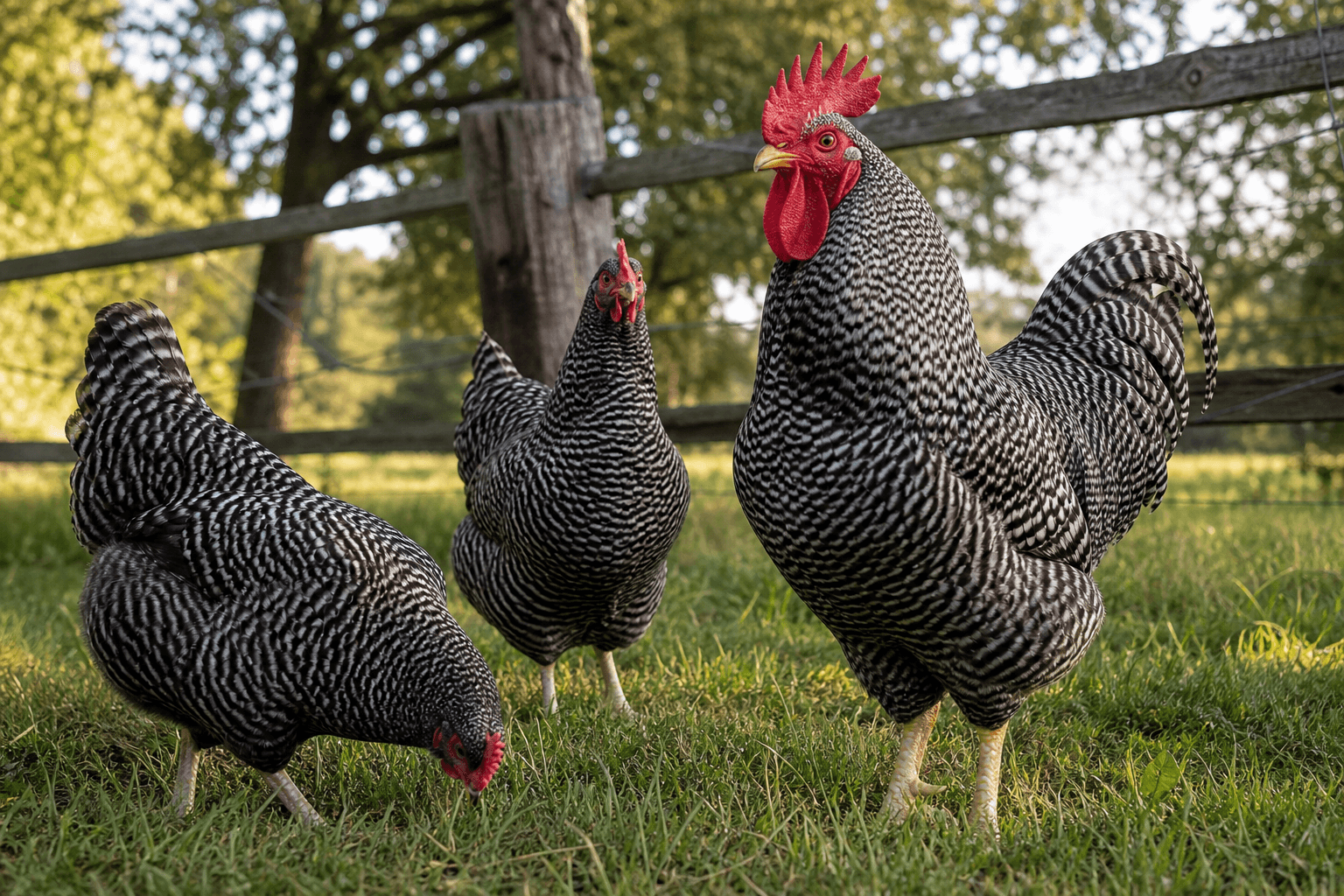
The Plymouth Barred Rock is one of those farm animals that feels familiar even before you know its history. The black-and-white barring is instantly recognizable. The body is sturdy. The look is practical, almost architectural. It is a chicken that seems to belong near a fence line, under an old tree, or in the margin of a seed catalog from another century.
At Shaggy Ink Farms, the Plymouth Barred Rock is our flagship breed. That choice is partly visual, partly practical, and partly historical. We chose Barred Rocks because they carry the kind of American farm identity we want the homestead to honor: useful, durable, family-scale, and rooted in a time when poultry was selected for more than speed and uniformity.
It is important to say this carefully. We are not claiming that our flock descends from a specific conservation line unless and until we can document that clearly. We are not claiming Good Shepherd Conservancy genetics. We are saying that the Plymouth Barred Rock as a breed deserves respect, and that the broader work of heritage poultry conservation has shaped how we think about keeping, documenting, and talking about our birds.
Origins in Nineteenth-Century America
The Plymouth Rock was developed in the United States during the middle of the nineteenth century. The Livestock Conservancy notes that birds called Plymouth Rocks were first exhibited in Boston in 1849, then effectively disappeared from view for about two decades before reappearing at a poultry show in Worcester, Massachusetts, in 1869. The later Worcester birds are generally treated as the ancestors of the Plymouth Rocks known today.
Like many old farm breeds, the origin story is not perfectly tidy. The Livestock Conservancy's breed history connects the breed to multiple contributors and possible crosses, including birds such as Dominiques, Javas, Cochins, Brahmas, and Spanish chickens. That kind of layered development is typical of practical nineteenth-century livestock breeding.
That uncertain origin is not a weakness. It is part of how many practical farm breeds came into being. Before genetic testing, national databases, and modern hatchery catalogs, breeds were formed by people selecting birds that worked: birds with the right size, vigor, feathering, temperament, body type, and utility. The Plymouth Rock became a breed because poultry people kept choosing and refining a useful kind of bird.
The original Plymouth Rock was barred, which is why the Barred Rock carries such authority inside the larger Plymouth Rock family. Other color varieties came later. The American Poultry Association accepted the breed into its Standard of Excellence in 1874, a date that matters because standardization helped turn local breeding work into a nationally recognized breed identity.
A Chicken Built for the American Farm
The Plymouth Rock became popular because it fit real farm needs. The Livestock Conservancy describes the breed as hardy, docile, broody, a good producer of brown eggs, and valued for meat qualities. In plain language, it was a dual-purpose bird: useful for eggs and table birds, not only one or the other.
That dual-purpose identity is central to its legacy. On small farms and family homesteads, specialization was not always a virtue. A bird that could lay, forage, tolerate weather, reproduce, and carry enough body to be useful at the table had lasting value. The Plymouth Rock's popularity before World War II reflected that practical fit. It was not just a pretty bird. It was a working bird.
The breed also played a role in the development of the modern broiler industry. The Livestock Conservancy notes that Plymouth Rocks were among the foundation breeds for broiler development in the 1920s. Later industrial poultry systems moved toward specialized hybrids, especially birds selected for rapid growth, uniformity, and efficiency at enormous scale. That shift changed the meaning of poultry breeding in America.
The Barred Rock, in that context, becomes a bridge. It connects the era of family farm utility to the era of modern poultry production. It reminds us that today's poultry industry did not appear from nowhere. It grew out of older breeds, older breeders, and older farm systems, then narrowed its priorities around the demands of industrial scale.
What Heritage Poultry Conservation Is Trying to Protect
The phrase heritage poultry can be used loosely in marketing, so definitions matter. The Livestock Conservancy's heritage chicken definition centers on several requirements: recognized standard breeds, natural mating, long productive outdoor lifespans, and slow growth. The definition is meant to protect more than nostalgia. It protects functional traits that can disappear when breeding is narrowed to a few commercial goals.
For a family homestead, those traits are not abstract. Natural mating matters because a breed should be able to reproduce without constant intervention. Outdoor vigor matters because a bird should be able to live a real chicken life with movement, weather, forage, and seasonal change. Slow growth matters because bodies need time to develop soundly. Longevity matters because breeding knowledge depends on watching birds over time.
Conservation also protects options. Rare and traditional livestock breeds can carry genetic diversity that may matter for future farming: disease resistance, hardiness, mothering ability, foraging behavior, climate adaptation, and body types that suit different production systems. Losing those traits would be a permanent narrowing of the agricultural toolbox.
This is where heritage poultry conservation becomes more than sentiment. It is not only about saving the look of old breeds. It is about preserving living populations with enough quality, numbers, and breeder knowledge to remain useful. A breed in a photograph is history. A breed in a carefully managed flock is possibility.
Frank Reese, Good Shepherd, and the Standardbred Conversation
Any respectful conversation about American heritage poultry eventually comes to Frank Reese of Good Shepherd Poultry Ranch in Kansas and the Good Shepherd Conservancy. Reese is widely discussed as one of the most important living advocates for Standardbred poultry and old production lines. Reporting and partner organizations have described his work as focused on preserving pre-industrial poultry genetics and keeping old breeds in active agricultural use.
Good Shepherd's work is often framed around Standardbred poultry, a term that emphasizes breeding to the American Poultry Association Standard and maintaining functional, historic lines. That distinction matters. A bird can have the name of an old breed and still be poorly selected. Conservation work depends on type, vigor, reproduction, records, and a breeder's willingness to make hard choices for the long-term health of the flock.
The Anne Saxelby Legacy Fund describes Good Shepherd Poultry Ranch as a major stronghold for important American market breeds, including Plymouth Rock, and connects the ranch to a wider conservation effort. Heritage Foods has also written about Frank Reese's work preserving poultry biodiversity and bringing older poultry genetics back into meaningful agricultural use.
For Shaggy Ink Farms, the lesson is not to borrow prestige from someone else's genetics. The lesson is humility. If we are going to use words like heritage, conservation, and bloodline, we need to use them carefully. We need to document what we know, avoid claims we cannot support, and respect the difference between owning birds of a breed and stewarding a proven conservation line.
Why Bloodlines Matter
A breed name is not the whole story. Within any breed, different flocks can vary widely in type, productivity, temperament, size, vigor, and historical selection. Bloodlines matter because they carry the decisions of breeders across generations. They are living records of what people selected for, what they ignored, and what they protected.
Preserving bloodlines does not mean freezing animals in time. Good breeding is active. It requires selection, culling, observation, and records. It asks breeders to balance appearance with function, individual birds with population health, and short-term convenience with long-term resilience. The goal is not to keep every bird. The goal is to keep a breed strong enough to remain itself.
That is why unsupported claims can do harm. If every flock is advertised as rare, historic, pure, or conservation-grade without evidence, the language loses meaning. Serious breeders and conservation organizations rely on clarity. Buyers and new flock owners need to know whether they are buying hatchery-quality backyard birds, exhibition stock, production-selected stock, or birds connected to a documented conservation program.
At our scale, the honest path is to start with respect and keep learning. We can choose a historic breed, observe our birds carefully, improve our husbandry, study the standard, learn from conservation sources, and be transparent about what we are and are not claiming. That is the foundation for better stewardship later.
Why We Chose Barred Rocks
We chose Plymouth Barred Rocks because they make sense for the kind of farm Shaggy Ink Farms is becoming. They are visually iconic, historically American, practical for a family homestead, and connected to a conservation conversation that deserves more attention. They photograph beautifully in oak pasture, but they also give us a daily reason to practice actual animal care.
Their barred feathers fit the visual world of the brand: rustic fencing, cream paper, charcoal ink, forest green, barn red, and warm gold light. Their history fits the storytelling world: American agriculture, family farms, breed standards, egg baskets, and the long tension between practical husbandry and industrial efficiency.
Most of all, Barred Rocks give us a starting point with depth. A flock can be charming on day one, but a breed with history gives you something to study for years. Where did it come from? What traits made it useful? What has modern poultry gained and lost? How do small farms talk honestly about conservation? How can a family homestead honor an old breed without overstating its own role?
Those are the questions we want to keep asking. The Plymouth Barred Rock is our flagship because it holds beauty, utility, and history in one bird. It belongs in a pasture, but it also belongs in a larger conversation about the future of small farms, food, biodiversity, and the breeds that helped build American agriculture.
At Shaggy Ink Farms, the Barred Rock is not a mascot pasted onto a brand. It is the beginning of a discipline. We are starting with a bird that asks us to pay attention, tell the truth, and build slowly enough that the story can carry weight.
Source Notes
Historical and conservation references used to keep this article careful and fact-based.